By Crystal Cassandra · Updated August 3, 2026
Crystal Healing Expert
Celestite vs Angelite: which should you choose?
Celestite and Angelite are both spirituality stones in the crystal-healing tradition. Choose Celestite when a bedside stone for calmer sleep; reach for Angelite when comfort to physically hold through a funeral or hospital season.
Set a Celestite cluster beside a polished Angelite palm stone and you are looking at the two grammars of the same pale blue: Celestite grows as glassy crystal points inside geodes, all sparkle and air, while Angelite comes as smooth, dense, matte material that carvers shape into angels and spheres. Both are traditionally angelic stones, and the choice is mostly about how you practice: Celestite suits the stationary altar and the bedside, a stone you go to, while Angelite suits the pocket and the palm, a stone that goes with you.
Quick Comparison
| Property | Celestite | Angelite |
|---|---|---|
| Chakra | Throat, Crown | Throat, Third Eye |
| Element | Air | Air |
| Primary Color | pale blue, sky blue | pale blue, lilac blue |
| Hardness (Mohs) | 3 | 3.5 |
| Key Intentions | meditation, calm, spiritual awakening | communication, calm, spiritual awakening |
About Celestite
Celestite, formally celestine, is strontium sulfate, named from the Latin caelestis, heavenly, and it leads a strange double life: collector geodes on one hand and the world's main strontium ore on the other, with sub-gem material crushed for crimson fireworks. The market's blue standard comes from Sakoany on Madagascar's Betsiboka River, hollow eggs lined with sky-blue points, and the largest known geode on Earth is a celestite cavity under an Ohio winery, struck in 1897. Judy Hall files Celestite among the high-vibration teaching stones, and its traditional posts are the meditation altar and the sleep space.
In my practice, Celestite is a destination stone. You do not carry it; you visit it, the cluster on the nightstand before sleep, the geode section on the altar before sitting practice. At Mohs 3 to 3.5 with easy cleavage it sheds points if handled roughly, and its blue bleaches in a sunny window, so give it soft light and stillness, which is rather the point.
For a deeper profile of this stone, see the full Celestite page.
About Angelite
Angelite is the trade name for the glacier-blue anhydrite that surfaced in Peru in 1987, one of the youngest names in the crystal cabinet, and nearly all of it still comes from the Casapalca mining district high in the Andes. Anhydrite means waterless, and the name doubles as a care instruction: soak it and it slowly converts toward gypsum, swelling and dulling as it goes. Judy Hall introduces Angelite as a stone of awareness, and the tradition assigns it to the throat: compassionate speech, prayer said quietly, comfort offered without fixing.
In my practice, Angelite is the companion piece Celestite cannot be: dense, smooth, pocketable, the stone a grieving client can hold through a funeral or a nervous one can thumb in a waiting room. Hold it while you look for the sentence and notice whether the words arrive slower and kinder. At $12 to $25 polished, it is gentle on every budget, which is part of why it travels so well.
For a deeper profile of this stone, see the full Angelite page.
Key Differences
- 1Celestite is strontium sulfate that grows glassy crystal clusters; Angelite is massive blue anhydrite, a calcium sulfate sold as smooth polished forms.
- 2Celestite is a stationary stone (altar, nightstand, soft light); Angelite is a portable one (pocket, palm, travel).
- 3Celestite's crystals cleave and shed with handling and its color fades in sun; Angelite survives carrying but must never be soaked, since water slowly turns it back toward gypsum.
- 4Celestite leans crown-ward, toward meditation and sleep; Angelite leans throat-ward, toward compassionate speech and comfort.
When to Use Them Together
Celestite and Angelite divide the angelic tradition into home and away games. Keep the Celestite cluster where your practice physically happens, bedside for sleep, altar for sitting, and let it stay put in soft light, since both sun and handling cost it. Carry the Angelite for everything else: hospital visits, hard phone calls, funerals, travel. Many people charge the Angelite beside the Celestite overnight, a small ritual of sending the messenger out from the temple, and the pairing makes one practice out of two very different objects.
Many people working with these stones also explore the Throat Chakra page, which gathers traditional pairings and balancing practices in one place.
Which One Is Right for You?
In my practice, the right stone is almost always the one that matches your current need. Many people find that one of these scenarios maps closely to where they are right now:
A bedside stone for calmer sleep
Celestite's traditional post is the nightstand, where its fragility never matters.
Comfort to physically hold through a funeral or hospital season
Angelite is dense, smooth, and pocketable, built for being held for hours.
Finding gentler words for hard conversations
Angelite is the throat-leaning angel stone, tied to compassionate speech.
A meditation altar centerpiece
A Celestite cluster anchors an altar visually and traditionally, and never needs to leave it.
Add These Stones to Your Practice
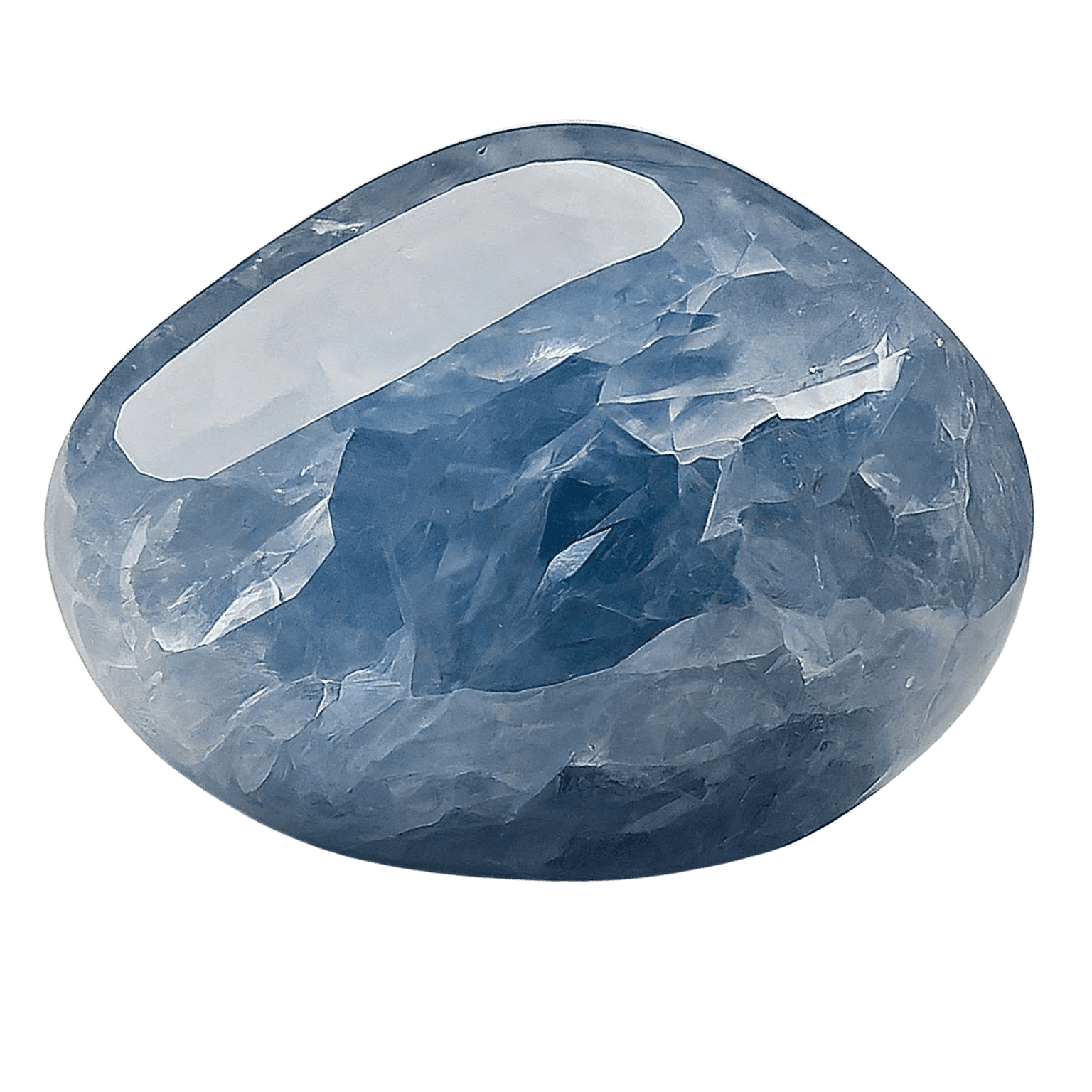
Celestite
A heavenly blue crystal of meditation, angelic connection, and serene peace.

Angelite
A soft blue stone of angelic connection, peace, and compassionate communication.
Still not sure which is right for you? Try the free Crystal Quiz for a personalized recommendation, or explore the crystal healing guide for foundational practice.
Frequently Asked Questions
Are Celestite and Angelite the same stone?
No, Celestite and Angelite are different minerals that share a color family: Celestite is strontium sulfate forming glassy crystals, while Angelite is blue anhydrite, a calcium sulfate sold as smooth massive material from Peru.
Which is better for sleep, Celestite or Angelite?
Celestite is the traditional sleep stone of the pair, kept as a small cluster on the nightstand. Angelite also suits bedrooms, but its real advantage is portability, which sleep does not require.
Can Angelite get wet?
No, Angelite must stay dry: it is anhydrite, the 'waterless' calcium sulfate, and soaking slowly converts it toward gypsum, swelling and dulling the stone. Cleanse it with sound, smoke, or moonlight.
Why is Celestite usually sold as clusters instead of jewelry?
Celestite is too fragile for jewelry: at Mohs 3 to 3.5 with easy cleavage, its crystals chip and shed points under daily wear. Clusters and geode sections preserve it, which is why the trade sells it that way.
Which angel stone should a beginner buy first?
Angelite is the easier first angel stone: affordable, durable enough to carry, and forgiving as long as it stays dry. Celestite rewards a settled practice space where its delicate cluster can simply stay put.
More Crystal Comparisons
Share Your Result
Vertical 9:16 format, perfect for Instagram Stories or TikTok. Opens in a new tab; long-press or right-click to save.
The Crystal Starter Library, free
Crystal Cassandra on choosing your first stones, keeping them safe, and building a practice around one intention rather than a shelf of good intentions.
We respect your inbox. Unsubscribe anytime.
Explore More Tools
Crystal Quiz
Find the perfect crystal for your current needs and intentions.
Open →Crystal Encyclopedia
Browse our complete library of 50+ healing crystals.
Open →Chakra Test
Discover which of your chakras are open, balanced, or blocked.
Open →Crystals by Intention
Find crystals matched to specific intentions and goals.
Open →Crystal Cleansing Guide
Learn how to cleanse and recharge your healing crystals.
Open →