
Quick Answer
Azurmalachite is a deep blue crystal used in modern crystal healing for communication, heart healing, and transformation. It measures 3.5 on the Mohs hardness scale and typically costs $18 to $55 for a tumbled stone. In the chakra tradition, Azurmalachite is associated with the Heart, Throat, and Third Eye chakras.
Worth knowing: Each piece is a chemical event frozen mid-act: malachite is the more stable mineral that azurite weathers into, so the green zones are literally the blue mineral's future.
“A blue-and-green copper composite of azurite and malachite, vivid heart-throat stone with strict care.”
- Chakra
- Heart (Anahata), Throat (Vishuddha), Third Eye (Ajna)
- Zodiac
- Scorpio ♏, Sagittarius ♐
- Element
- Water 💧
- Planet
- Venus ♀
- Hardness
- 3.5 / 10 (Mohs)
- Colors
- Deep blue, Green, Banded
- Origin
- DR Congo, Morocco, USA (Arizona)
- Price Range
- 18 to 55
Care + Safety
Azurmalachite at a glance
- Water: avoid, may damage or leach
- Sun: fades in prolonged direct sun
- Mohs hardness: 3.5 (display + meditation only)
What is Azurmalachite?
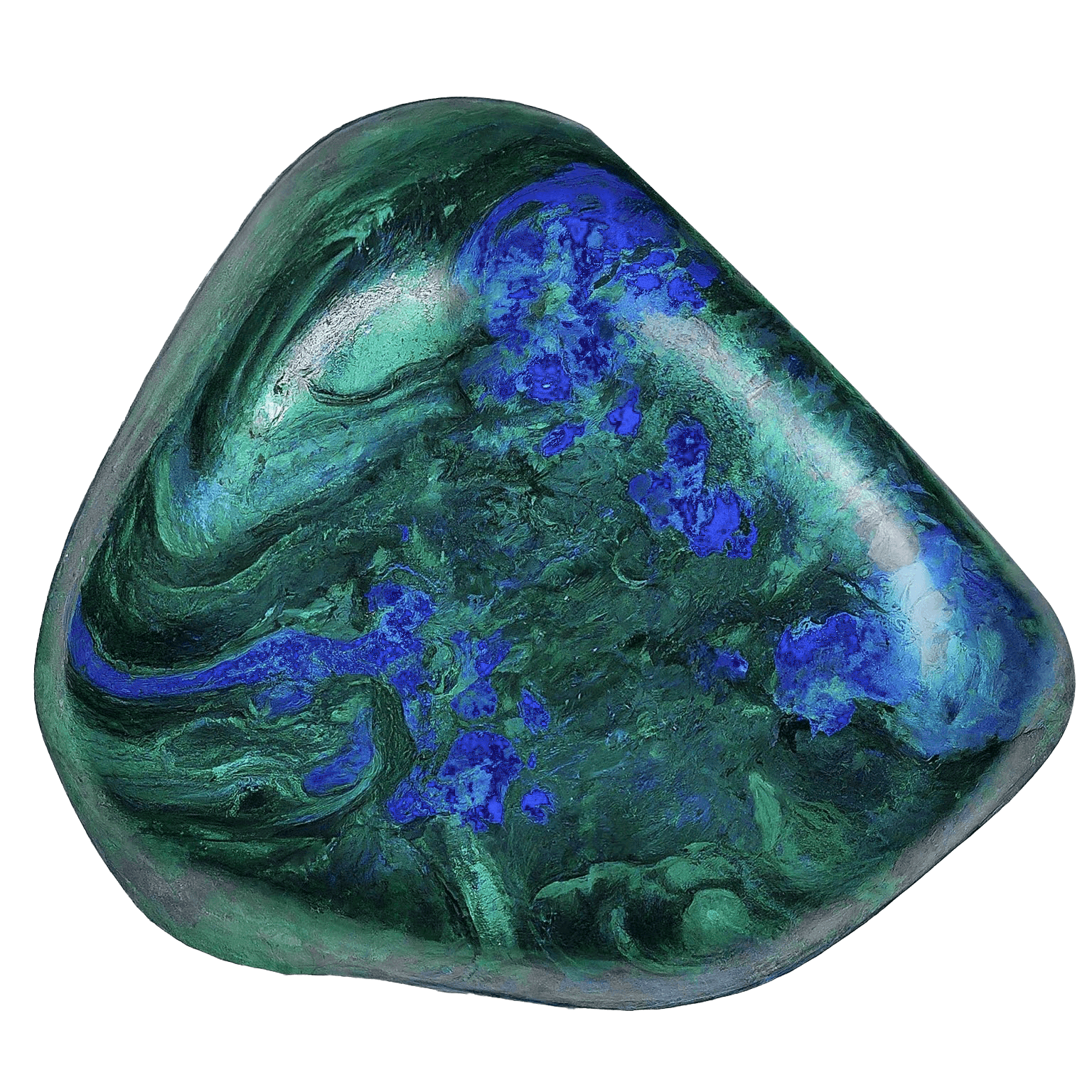
Azurmalachite is the banded intergrowth of two copper carbonates, azurite's blue swirled against malachite's green, cut from oxidized copper deposits in DR Congo, Morocco, and Arizona. Soft at 3.5 and copper-rich, it is polished, sealed, and kept dry.
Azurmalachite measures 3.5 on the Mohs scale and shows deep blue, green, or banded coloring. Most of its assignments happen at desks and in conversations; communication, heart healing, and transformation are its catalog entries, all of them about clearing the air.
The stone connects primarily to the Heart (Anahata) and Throat (Vishuddha) and Third Eye (Ajna) chakras, carrying Water energy. Sources include DR Congo, Morocco, and USA (Arizona); deposit matters more than beginners expect, and collectors learn to recognize where a piece of Azurmalachite was mined by its color depth and pattern.
Azurmalachite is a natural co-formation of azurite and malachite, swirled together in vivid blue-and-green bands. The tradition reads its two colors as a heart-and-throat pairing; hold it and notice which of the bands your eye keeps following. Because both parent minerals are copper carbonates, this stone is firmly off-limits for water elixirs and benefits from sealed display in damp climates.
Also catalogued as Azurite-Malachite, whether it is your first stone or your fiftieth, Azurmalachite tends to find its role quickly, and communication is the natural place to begin.
History and Mythology
There is no credible ancient chapter to tell about Azurmalachite. The species was described by modern science, and its associations with communication were assigned by contemporary practitioners reading its color, structure, and feel. What the stone lacks in legend it makes up in geology, which asks for no embellishment; deposits worked today lie in DR Congo, Morocco, and USA (Arizona).
Astrologically minded practitioners file Azurmalachite under Scorpio and Sagittarius and give Venus ♀ the rulership. The pairing is a 20th century convention rather than an ancient decree, and it is read as favoring communication work.
Whatever the age of the name, the geology is patient: every piece of Azurmalachite took shape over geological timescales, arriving at its Mohs 3.5 hardness through slow heat, pressure, and chemistry long before any hand reached for it.
Azurmalachite Meaning and Metaphysical Properties
What the Hand Learns First
The hand learns Azurmalachite fast: a Mohs 3.5 stone whose deep blue face warms readily and carries a soft luster that invites the thumb to keep circling it. Look up from the stone after a minute and check the room; many people working with clarity stones describe edges firming and attention narrowing to a single point.
Primary Properties
The property list for Azurmalachite is a thinking list: communication, heart healing, transformation, and intuition. This is the family for desk work and hard conversations, anywhere fog needs to lift before words can land. Use the stone as a session marker, same place, same task, and let repetition build the association.
How Crystal Energy Works
At the center of the chakra map sits the Heart, and that crossroads is where tradition places Azurmalachite for its communication work. Practice here follows the breath rather than the clock: the stone at the chest, attention settling on communication, heart healing, and transformation, force left at the door. In Judy Hall's grouping the clarity family sits with the throat and brow centers, and her write-ups for it have the flavor of study aids, all focus, articulation, and honest speech.
Amplification Through Intention
Azurmalachite carries Water in the elemental system, feeling, memory, tide, and that current sets the tempo of its communication work. Use the slow hours, journaling, the evening review, the long unwinding, and let communication, heart healing, and transformation arrive at their own pace.
Healing Benefits
Emotional Support
Composure is the feeling Azurmalachite is traditionally asked to support: communication, heart healing, and transformation. Bring it to the tangled days, the ones where the emotion is unmistakable but the sentence for it will not come. Tradition, not treatment: communication work with a stone sits beside professional support, never in place of it.
Spiritual Connection
Azurmalachite belongs to the truth-telling line of spiritual work: the journal that does not flinch, the conversation finally had. Tradition places it with practices of honest speech and honest seeing, with the Heart center as the working site.
Physical Presence
Tradition pairs Water stones like Azurmalachite with the body's tides: rest, hydration, the wind-down hour that makes room for communication. Let it sit on the night table as a cue for the evening glass of water and the earlier lights-out; gentle cues, never medicine.
Chakra Connection
Azurmalachite resonates most strongly with the Heart (Anahata), the energy center traditionally drawn in green / pink and the traditional seat of this stone's communication work. When this center runs clear, the classical markers are warmth toward others, compassion that includes yourself, and an open emotional door; communication, heart healing, and transformation are what Azurmalachite is most often asked to bring to it.
Worn over the heart on a longer chain, or held flat to the chest before hard conversations, Azurmalachite keeps the heart center company through the day's communication work.
Because Azurmalachite is also associated with the Throat (Vishuddha) and Third Eye (Ajna), it moves well in multi-stone layouts: one stone, two stations, worked on different days.
Zodiac and Astrological Connection
In the modern correspondence tables Azurmalachite is assigned to Scorpio ♏ (Oct 23 to Nov 21) and Sagittarius ♐ (Nov 22 to Dec 21); a Sun, Moon, or rising placement there is read as a head start with this stone, nothing more.
Correspondence is a suggestion, not a bouncer; plenty of devoted Azurmalachite keepers have no Scorpio in their chart at all, and being drawn to the stone is the credential that matters.
In the planetary layer of the system, Venus ♀ holds the rulership, and that planet's prominent transits are the traditional windows for deeper communication work with Azurmalachite.
How to Use Azurmalachite
These are the five ways of working with Azurmalachite I suggest most often. Begin wherever your attention goes first; the sequence matters far less than starting.
- 1
Meditation Hold
Hold Azurmalachite for the length of your sit and notice the moment it stops feeling like an object and starts feeling like part of the hand; for a Mohs 3.5 stone, that shift comes early.
- 2
Body Placement
Center-chest is the station the chakra charts give Azurmalachite: lie back, set it over the heart, and let each breath rock it gently. Keep the attention on the stone rather than on yourself, which is harder than it sounds and is most of the skill. The standing association at this center is communication.
- 3
Sleep Companion
Azurmalachite can still earn the nightstand even though its brief is communication rather than rest: setting the stone down as you set the day down marks the switch from doing to sleeping.
- 4
Carry With You
Take Azurmalachite into the marathon meetings and the stubborn drafts, and touch it deliberately whenever the thread knots; the two-second reset compounds, and in a few weeks it has become a working communication habit.
- 5
Crystal Grid Anchor
For grid work, give Azurmalachite the anchor position and run Azurite and Malachite on the outer points, all matched to a single communication intention. Rebuild it when it goes stale; a communication grid you have stopped seeing has stopped working.
How to Cleanse and Charge
Azurmalachite works best when it is cleansed on a rhythm; tradition pictures a stone absorbing what it meets, and a saturated stone has nothing left to give. The complete water, sun, and salt safety profile, plus the storage instructions I give my clients, lives in the dedicated Azurmalachite care guide.
- 1
Moonlight
Once a month, let Azurmalachite sit overnight in moonlight, on the full moon if you can manage it. Nothing in the cabinet is harmed by this method, which is why it anchors most cleansing routines.
- 2
Sage
For a deeper reset, hold Azurmalachite in sage smoke and name out loud what the stone has been carrying; the naming is half the cleanse.
- 3
Sound
Hold Azurmalachite near a singing bowl, bell, or tuning fork and let a full minute of tone wash over it; sound reaches stones that water, salt, and sun cannot safely touch.
- 4
Selenite
Lay Azurmalachite on a selenite plate or alongside a selenite wand overnight; selenite is the tradition's self-cleaning shelf, no effort, no risk to the stone.
How often to cleanse
Monthly is the floor for Azurmalachite; step the cadence up whenever the stone is in daily rotation or the season is emotionally loud. With practice you will feel the tell yourself, a worked stone reads heavier and flatter in the palm.
Charging after cleansing
Once it is cleansed, recharge Azurmalachite by setting it on a selenite plate overnight or bathing it in full moonlight; cleansing empties the stone, charging refills it.
Crystal Pairings
Treat pairing Azurmalachite as outfitting a workbench, not dressing a display. Each traditional partner is a tool with a job, focus, voice, or nerve, and the working limit is two stones per communication task; clutter is the one enemy clarity cannot negotiate with.
How to Spot Real vs Fake Azurmalachite
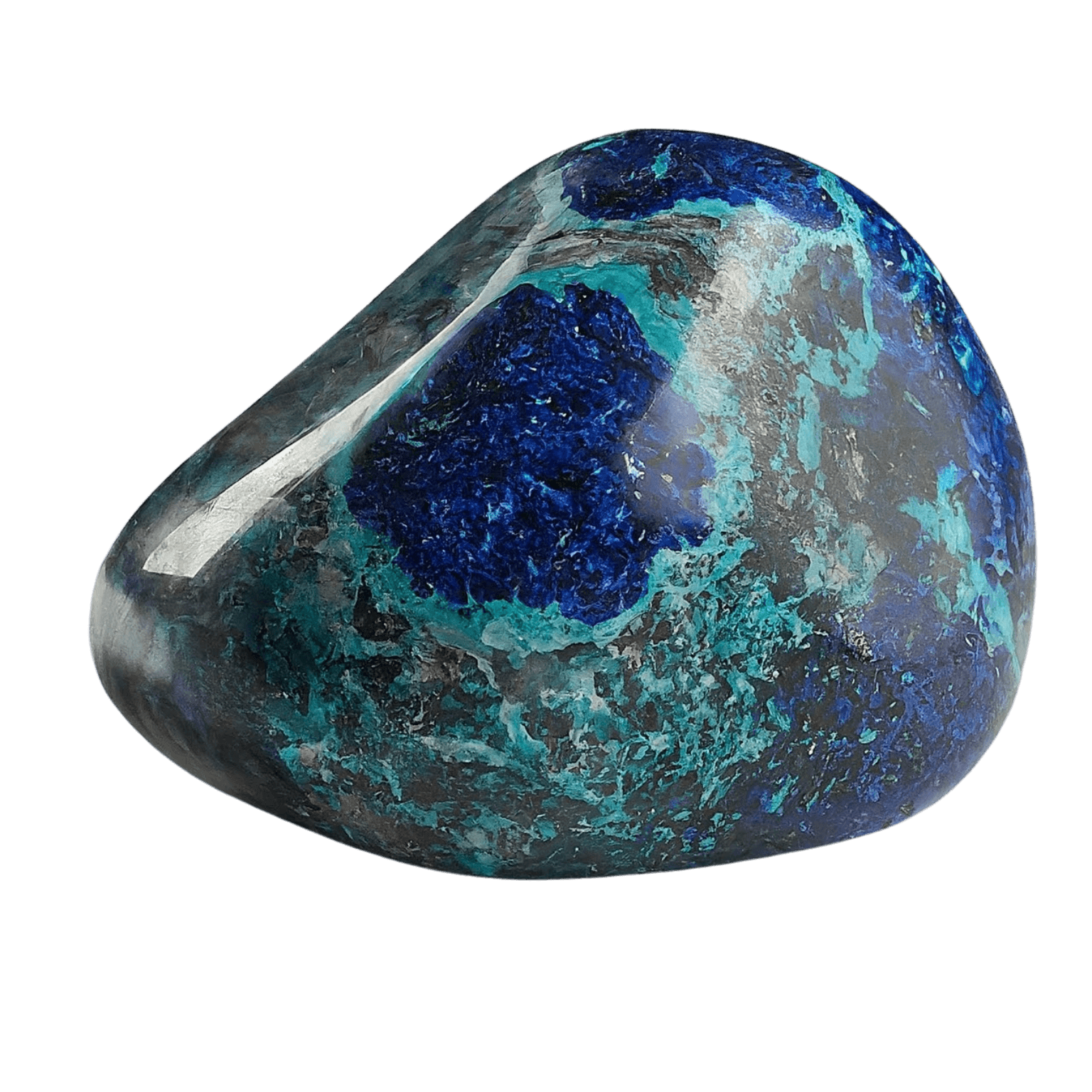
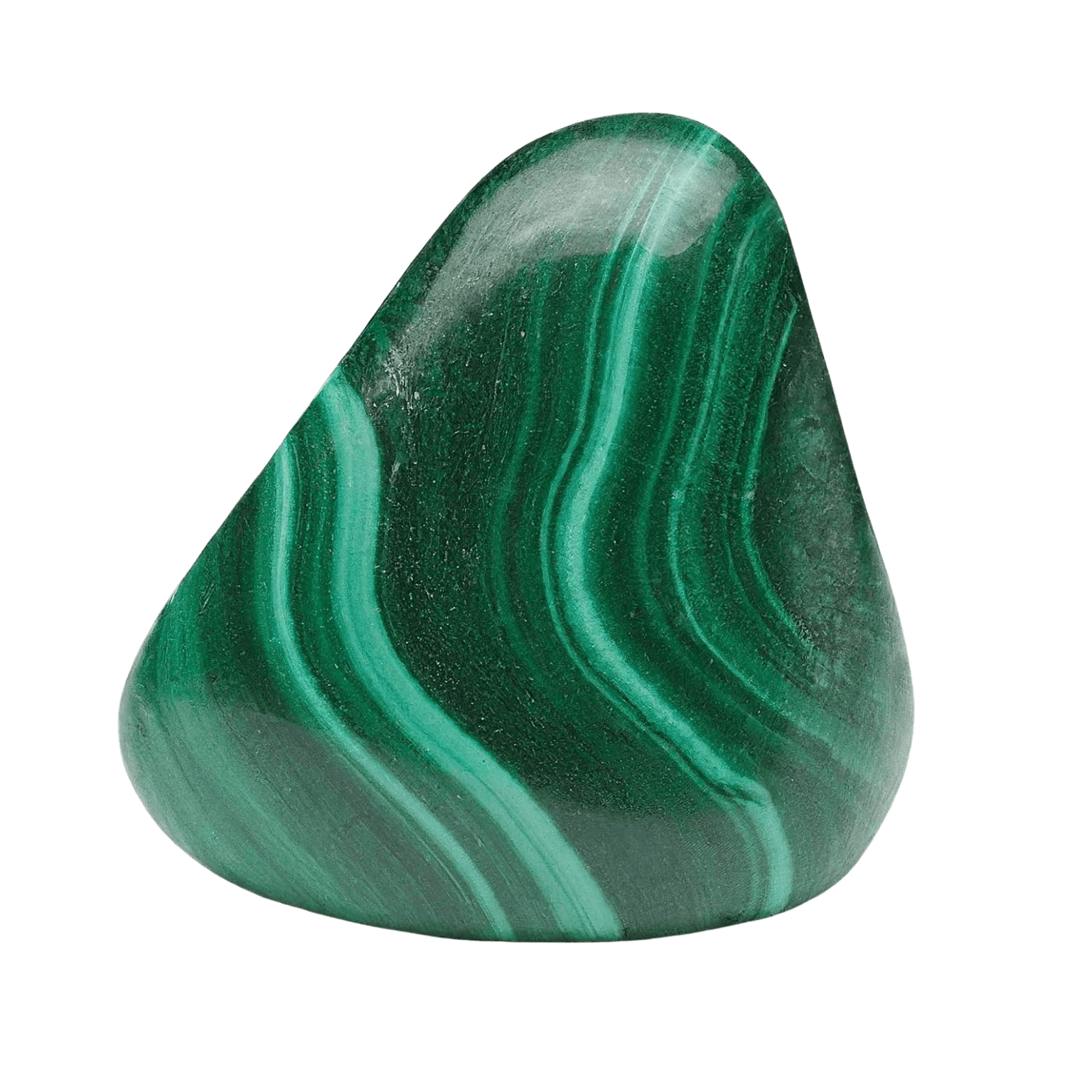
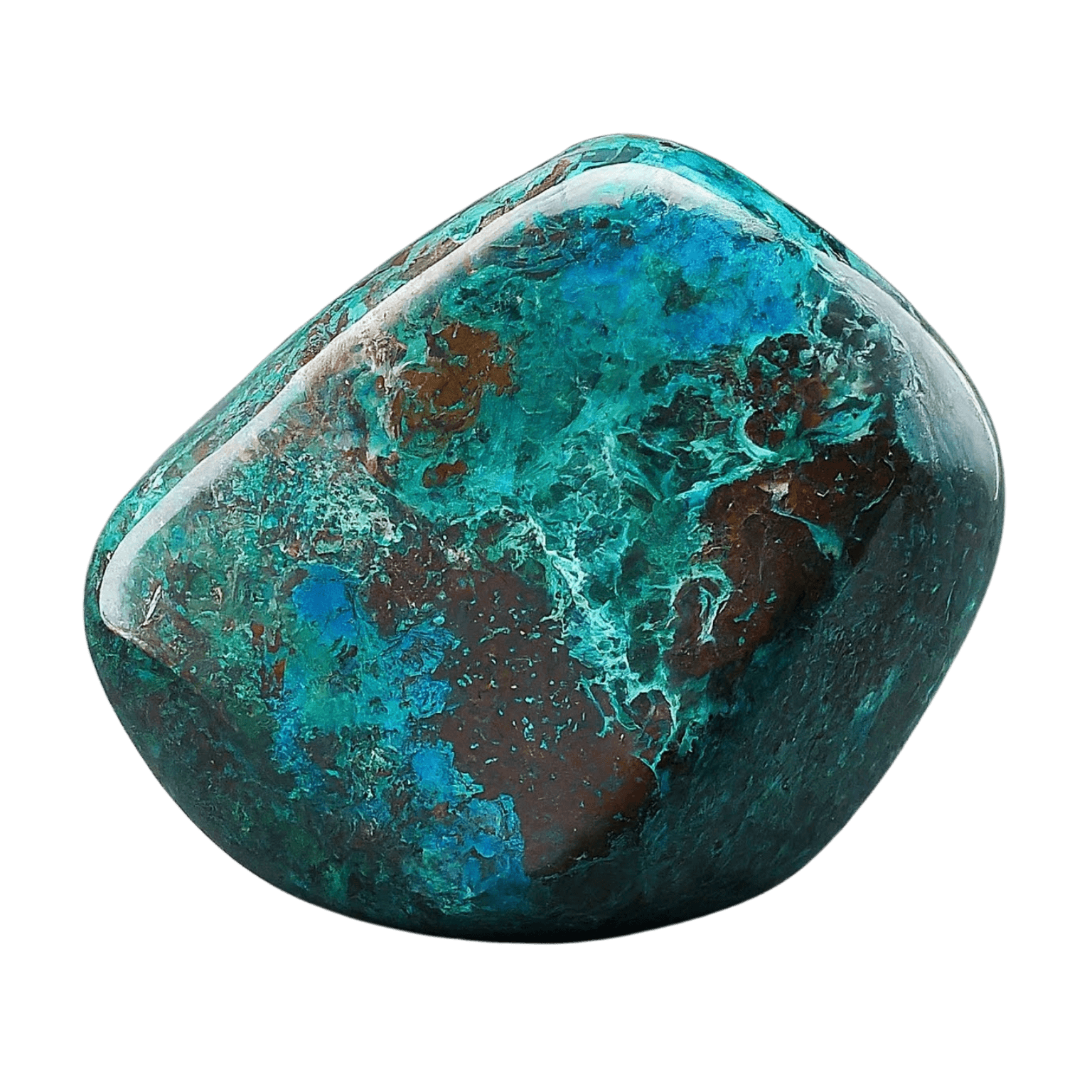
Imitations of Azurmalachite exist because demand does. A few hands-on checks separate genuine deep blue material from glass, resin, and dye:
Temperature: at Mohs 3.5, genuine Azurmalachite warms in the hand noticeably faster than glass; an imitation in glass stays cold and slick well past the first minute.
Weight and density: resin fakes run light for their size, while genuine Azurmalachite at Mohs 3.5 carries honest mineral density; weigh it in the palm against any real tumbled stone you own.
Color: expect deep blue, green, or banded with honest variation, banding, zoning, the odd inclusion; a batch where every stone matches exactly came out of a factory, not the ground.
Price reality: quality Azurmalachite runs roughly $18 to $55 for palm-sized pieces from reputable sellers; a price far below that range is usually answering a question you should have asked.
Trust your source: buy Azurmalachite from sellers who can name the mine or region behind their deep blue stock and disclose treatments without being chased. At CrystalStones.com every piece is ethically sourced with full provenance.
Bring it home
Shop Azurmalachite
Ethically sourced, hand-selected Azurmalachite starting from $18.
Shop AzurmalachiteFrequently Asked Questions
What is Azurmalachite good for?
Azurmalachite is traditionally associated with communication, heart healing, transformation, and intuition. Many people find it supportive for communication and for working with the Heart, Throat, and Third Eye chakras.
Can Azurmalachite go in water?
No, water and Azurmalachite do not mix; moisture can compromise the surface or the structure itself. Copper-rich. Never water, never elixir, wash hands after handling raw pieces. Soft (Mohs 3.5) and dust-fragile.
Can Azurmalachite be in the sun?
Keep it brief. Prolonged direct sun can fade the deep blue coloring of Azurmalachite, so a few morning minutes are fine but moonlight is the safer charging method.
What chakra is Azurmalachite?
Azurmalachite is primarily associated with the Heart (Anahata) and Throat (Vishuddha) and Third Eye (Ajna) chakras. In placement practice it belongs over the heart center, rocked gently by the breath while you lie still, the station tradition reserves for communication.
What zodiac sign is Azurmalachite for?
Azurmalachite is traditionally connected to Scorpio and Sagittarius. If your signs differ, work with Azurmalachite anyway; resonance in the hand outranks resonance on paper in every practical tradition.
How do I cleanse Azurmalachite?
Stick to Moonlight, Sage, and Sound for Azurmalachite; those are the methods its care profile recommends. Dry methods make up the entire list on purpose, since this stone's chemistry asks to be kept away from moisture.
Is Azurmalachite real or fake, how can I tell?
Genuine Azurmalachite warms quickly in the hand at Mohs 3.5, while glass imitations stay cold longer and feel slick rather than satiny. Expect natural variation in its deep blue coloring and a price near $18 to $55 for tumbled pieces; uniform color at a bargain price is the classic warning sign.
What’s Next?
A few thoughtful next steps if Azurmalachite is calling to you.
The Crystal Starter Library
A free guide from Crystal Cassandra: the twelve stones that cover almost everything, a one page care matrix for water, sun and salt, and how to build a first intention practice.
We respect your inbox. Unsubscribe anytime.
Explore More Tools
Crystal Quiz
Discover which crystal matches your energy right now.
Open →Chakra Test
Find which chakras need attention and the crystals to balance them.
Open →Crystal Cleansing Guide
Learn how to safely cleanse and charge your crystals.
Open →Crystals by Intention
Find the perfect crystal for what you need right now.
Open →