
Quick Answer
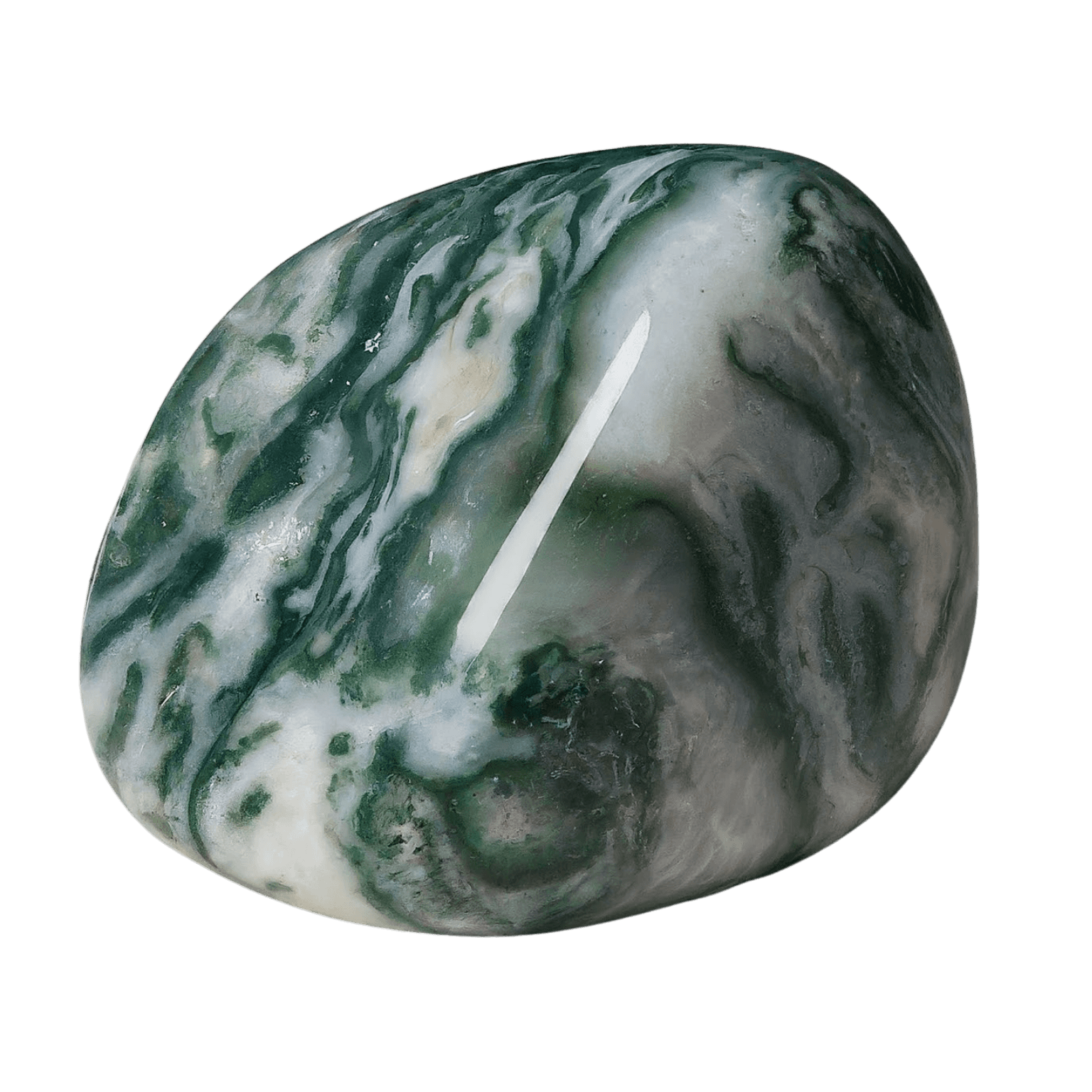
Tree Agate is a white crystal used in modern crystal healing for grounding, abundance, and calm. It measures 7 on the Mohs hardness scale and typically costs $6 to $18 for a tumbled stone. In the chakra tradition, Tree Agate is associated with the Heart and Root chakras.
Worth knowing: The trees inside tree agate are entirely inorganic: dendrite comes from the Greek dendron, meaning tree, and the fern-like growths are mineral crystallization patterns, not fossilized plants, despite generations of hopeful misreadings.
“A white chalcedony with green dendritic inclusions, of plant connection, growth, and abundance.”
- Chakra
- Heart (Anahata), Root (Muladhara)
- Zodiac
- Virgo ♍, Capricorn ♑
- Element
- Earth 🌍
- Planet
- Venus ♀
- Hardness
- 7 / 10 (Mohs)
- Colors
- White, Green dendrites
- Origin
- India, USA, Brazil
- Price Range
- 6 to 18
Care + Safety
Tree Agate at a glance
- Water: brief rinse safe
- Sun: tolerates sunlight charging
- Mohs hardness: 7 (durable for daily-wear jewelry)
What is Tree Agate?
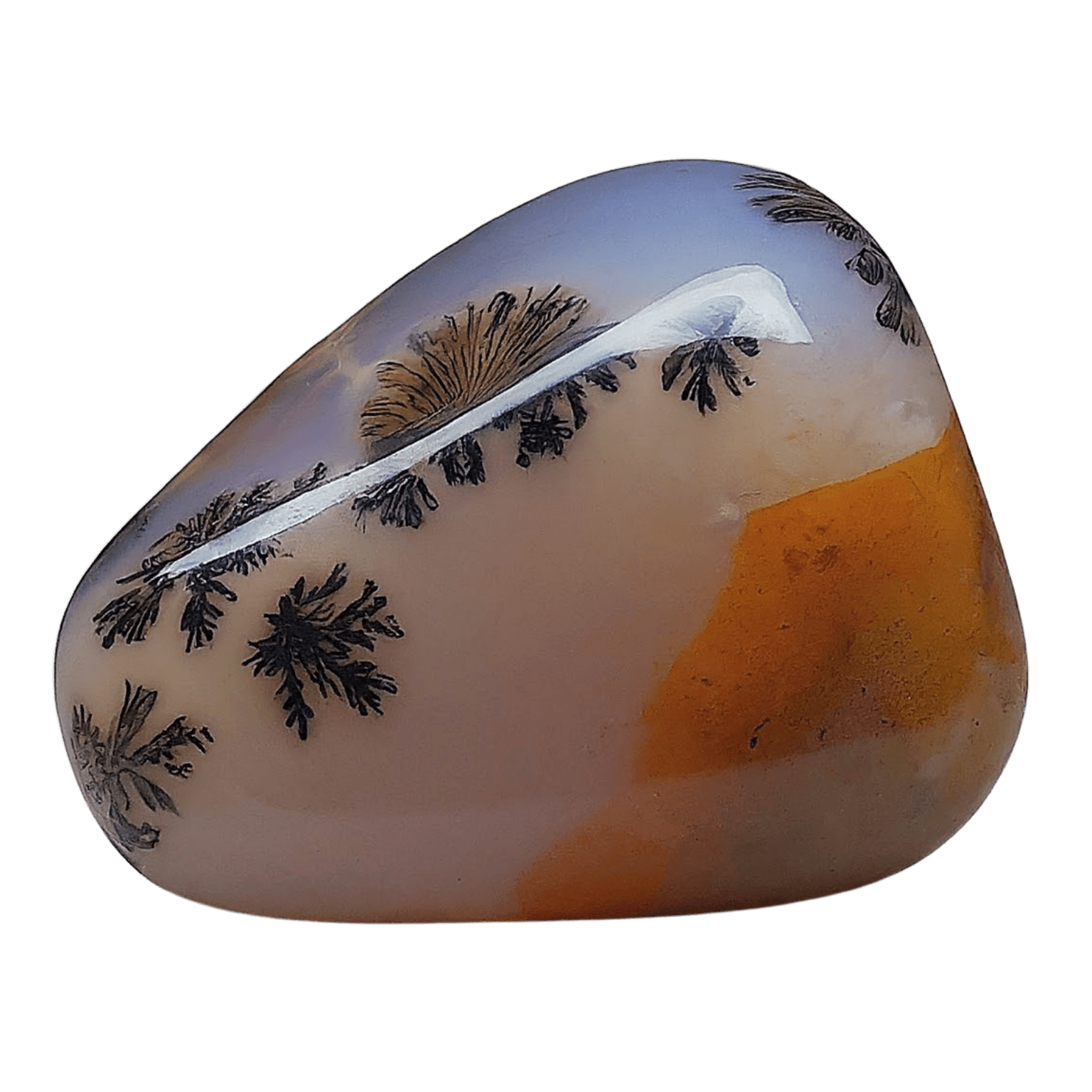
Tree agate is white chalcedony veined with green dendrites, branching films of iron- and manganese-bearing minerals that crept along microscopic fractures as mineral-laden water seeped through. Strictly speaking it is dendritic chalcedony rather than true agate, since it lacks the concentric banding that defines agate proper.
Tree Agate measures 7 on the Mohs scale and shows white or green dendrites coloring. Practitioners shelve it with the keeper stones at the protective end of the catalog, where grounding, abundance, and calm are the standing requests.
The stone connects primarily to the Heart (Anahata) and Root (Muladhara) chakras, carrying Earth energy. Today the material is drawn from India, USA, and Brazil. Hold pieces from two different sources side by side and the differences in the white material, tone, translucency, pattern, become obvious fast.
Tree Agate is white chalcedony with green dendritic inclusions that look like miniature trees inside the stone. Hold this stone and notice a verdant, growing-thing steadiness. The classical sources describe Tree Agate as a stone of plant connection, slow growth, and the patient unfolding of abundance.
Also catalogued as Dendritic Agate and Plume Agate, whether it is your first stone or your fiftieth, Tree Agate tends to find its role quickly, and grounding is the natural place to begin.
History and Mythology
Be clear about what Tree Agate is: a commercial name from the modern lapidary market, not a classical mineral with centuries of documentation. Its workings, including the grounding association, were proposed by contemporary practitioners, which has an upside, the guidance is specific, current, and written for how people actually use stones today. Material is cut from deposits in India, USA, and Brazil.
Astrologically minded practitioners file Tree Agate under Virgo and Capricorn and give Venus ♀ the rulership. The pairing is a 20th century convention rather than an ancient decree, and it is read as favoring grounding work.
Whatever the age of the name, the geology is patient: every piece of Tree Agate took shape over geological timescales, arriving at its Mohs 7 hardness through slow heat, pressure, and chemistry long before any hand reached for it.
Tree Agate Meaning and Metaphysical Properties
First Touch
Tree Agate announces itself through temperature: a cool, white, glass-polished weight at Mohs 7 that warms deliberately, not instantly, inside a closed palm. Notice your weight while you hold it, feet on the floor, seat in the chair; with grounding stones the tradition points attention toward ballast rather than toward tingle.
Primary Properties
The working properties of Tree Agate cluster at the protective end: grounding, abundance, calm, and manifestation. This family teaches containment, a settled spine, a slower breath, a clear sense of where you end and the room begins. The list is traditional shorthand; the stone meets whatever version of steadiness you actually need.
How Crystal Energy Works
At the center of the chakra map sits the Heart, and that crossroads is where tradition places Tree Agate for its grounding work. Practice here follows the breath rather than the clock: the stone at the chest, attention settling on grounding, abundance, and calm, force left at the door. Melody's Love Is in the Earth describes the grounding stones through the root connection, the energetic cord she pictures running from the base of the spine into the earth itself.
Amplification Through Intention
Tree Agate is classed as an Earth stone, patient, bodily, hard to knock over, which sets the pace of its grounding work. Prefer routines over ceremonies, the same pocket, the same desk corner, and let consistency do for grounding, abundance, and calm what intensity cannot.
Healing Benefits
Emotional Support
Tree Agate works the defended-and-rooted layer of feeling: grounding, abundance, and calm are its traditional emotional assignments. Keep it near on the porous days, the ones where every mood in the room seems to walk straight in. Tradition, not treatment: grounding work with a stone sits beside professional support, never in place of it.
Spiritual Connection
In spiritual work Tree Agate plays the doorkeeper: it is the stone tradition assigns to opening and closing practice, the grounding breath before inner work and the deliberate return after. Boundaries, in this family, are a devotion of their own.
Physical Presence
Physically, Tree Agate belongs to the slow systems: steady meals, regular sleep, the unglamorous maintenance that grounding actually rests on. Keep it where the routines happen as a quiet vote for keeping them; anything clinical belongs with clinicians.
Chakra Connection
Tree Agate resonates most strongly with the Heart (Anahata), the energy center traditionally drawn in green / pink and the traditional seat of this stone's grounding work. When this center runs clear, the classical markers are love, compassion, and emotional openness; grounding, abundance, and calm are what Tree Agate is most often asked to bring to it.
Lie down with Tree Agate at the heart center, letting the breath rock it; a quiet unmeasured stretch of that is the oldest heart-stone session in the book, and grounding is the usual request.
Tree Agate also keeps a working line to the Root (Muladhara), which widens its range in layouts; let the primary placement lead, and add the second position once the first feels familiar.
Zodiac and Astrological Connection
Tree Agate appears under Virgo ♍ (Aug 23 to Sep 22) and Capricorn ♑ (Dec 22 to Jan 19) in the standard correspondence tables; if those signs are loud in your chart, expect the introduction to feel familiar.
None of this is exclusionary. If Tree Agate keeps catching your eye, that interest counts for more than whether Virgo appears anywhere in your chart.
In the planetary layer of the system, Venus ♀ holds the rulership, and that planet's prominent transits are the traditional windows for deeper grounding work with Tree Agate.
How to Use Tree Agate
Five practices suit Tree Agate especially well. Pick the one that fits the day you are actually having rather than the routine you think you should have.
- 1
Meditation Hold
Take up Tree Agate and register the first cool touch; a glassy stone at Mohs 7 warms slowly, and tracking that gradual change is a meditation in itself.
- 2
Body Placement
Heart-center layouts hand the pacing to the breath: Tree Agate rides the rise and fall while you lie still. Watch the stone rise and settle, and let the watching be the entire practice. In my own sessions the noticing is what stays with me long after the stone has gone back on the shelf. The request the old charts attach here is grounding.
- 3
Sleep Companion
At night, park Tree Agate on the nightstand rather than working it; its job is the day's grounding, and ending the day cleanly is how tomorrow's session starts well.
- 4
Carry With You
Bring Tree Agate along when the calendar promises crowds, noise, or rooms you would rather skip. Each touch-check restates the boundary, two seconds of contact saying that grounding travels with you.
- 5
Crystal Grid Anchor
Set Tree Agate at the center of a grid built for grounding and ring it with Agate Dendritic and Agate Moss at the points. Speak the intention once as you place each stone; a grid is a sentence written in minerals, and saying the grounding aloud is the punctuation.
How to Cleanse and Charge
Tree Agate works best when it is cleansed on a rhythm; tradition pictures a stone absorbing what it meets, and a saturated stone has nothing left to give. The complete water, sun, and salt safety profile, plus the storage instructions I give my clients, lives in the dedicated Tree Agate care guide.
- 1
Water
Hold Tree Agate under cool running water for a minute or two, picturing the stream carrying off what the stone has absorbed, then pat it fully dry with a soft cloth.
- 2
Moonlight
Give Tree Agate a night outdoors or at the glass under a bright moon; the tradition holds moonlight to be the universal reset, slow, cool, and risk-free.
- 3
Sage
Pass Tree Agate through the smoke of white sage or rosemary for about thirty seconds, turning it so the smoke wraps every face, while you hold a clear intention of release.
- 4
Sound
A minute inside strong, sustained tone, bowl, chime, even a steady hum, resets Tree Agate without physical risk, which makes sound the safest deep cleanse for fragile stones.
- 5
Earth
Give Tree Agate twenty-four hours in the ground, with the spot marked so you can find it again; earth burial is the slow, thorough cleanse for stones that feel truly saturated.
How often to cleanse
Monthly is the floor for Tree Agate; step the cadence up whenever the stone is in daily rotation or the season is emotionally loud. With practice you will feel the tell yourself, a worked stone reads heavier and flatter in the palm.
Charging after cleansing
Follow every cleansing with a charge: for Tree Agate that means placing it in morning sunlight for 30 minutes. A cleared stone is neutral, a charged one is ready.
Crystal Pairings
Wall-building is the right metaphor for pairing Tree Agate: mass in one stone, lookout in the other. Tradition divides its partners along that line, the holders and the watchers. A brief two-stone hold before committing tells you what you need; ease is approval.
How to Spot Real vs Fake Tree Agate
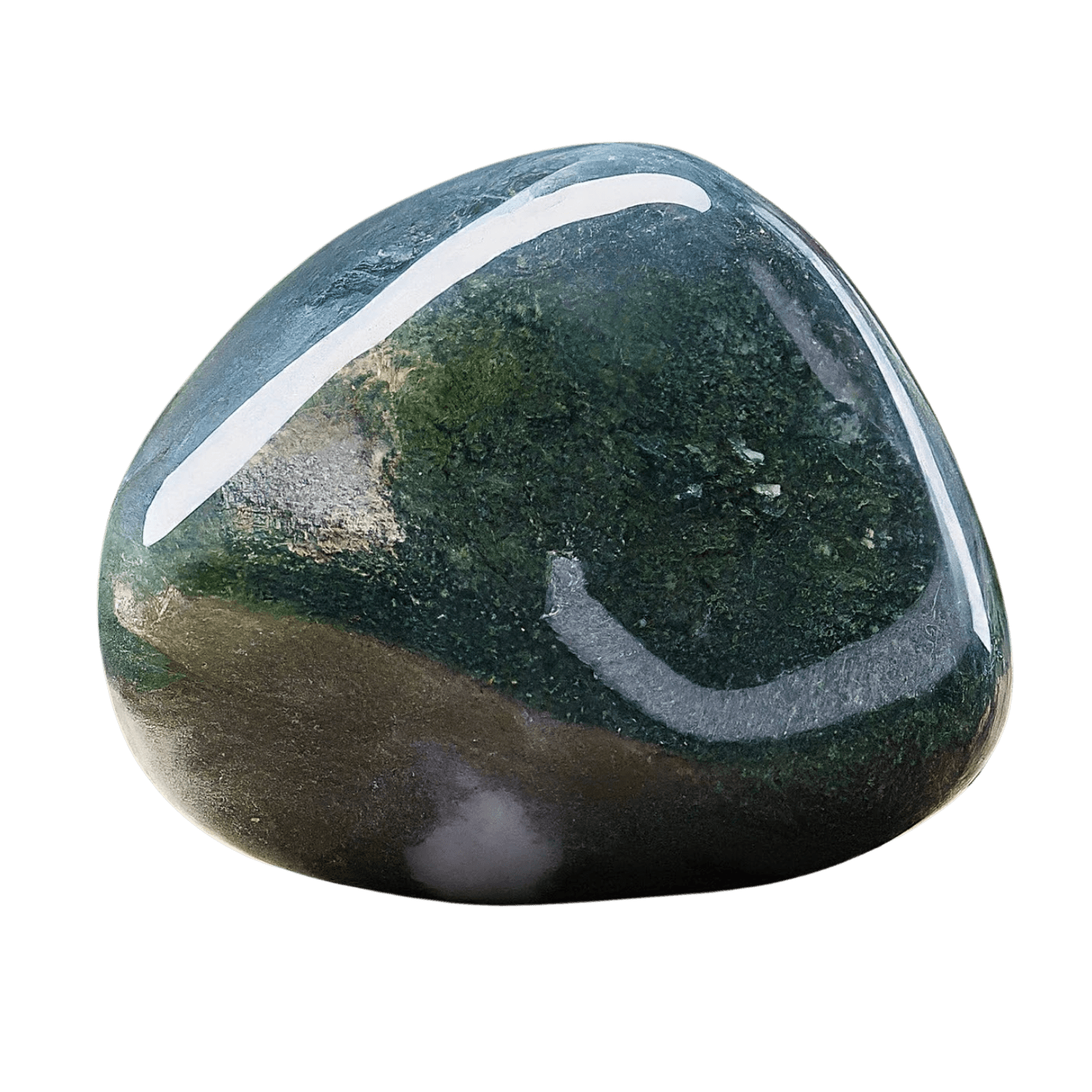
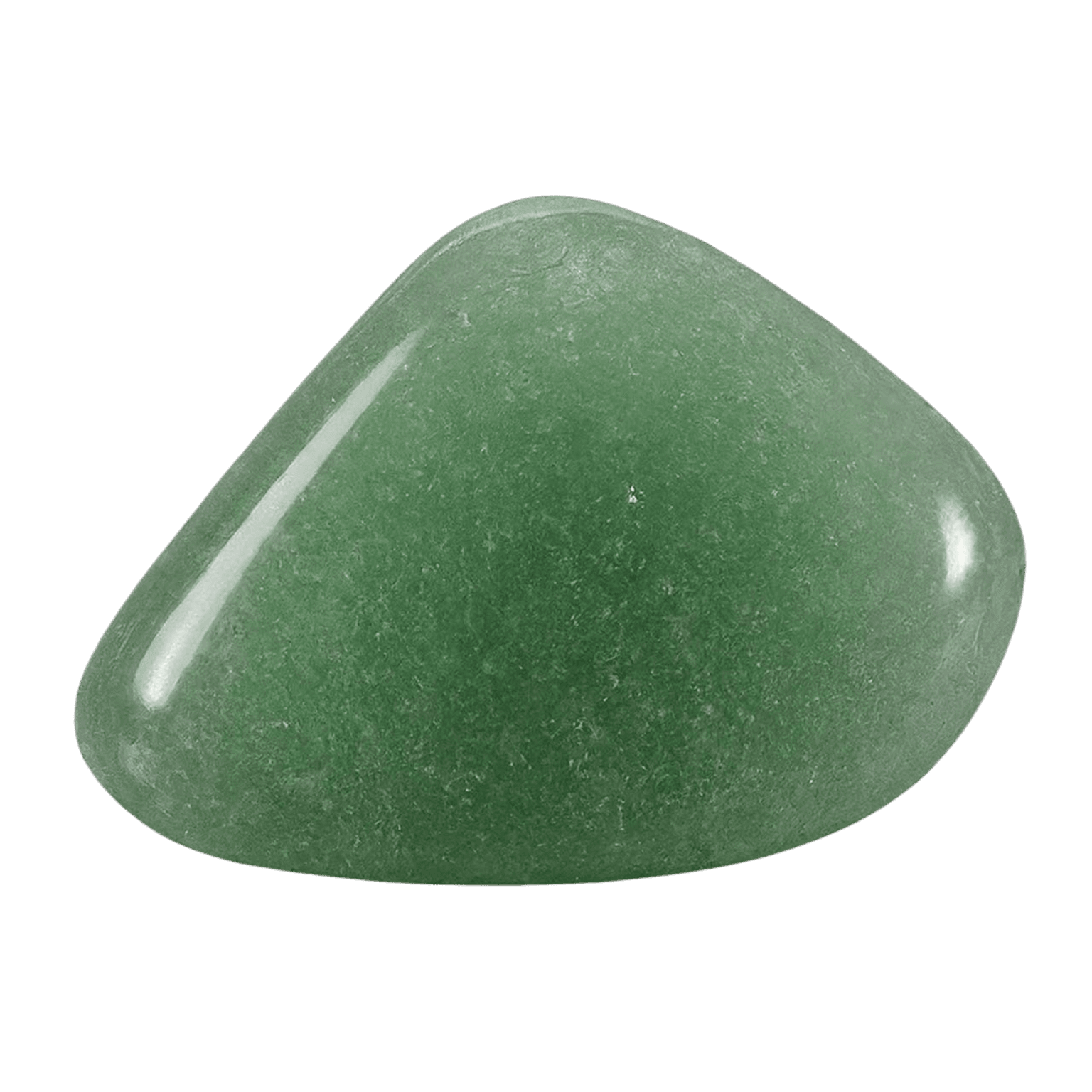
The market in Tree Agate has grown faster than its honesty, and white pieces are easy to imitate on a screen. Here is how to check one before you pay for it:
Temperature: genuine Tree Agate feels distinctly cool at first touch and gives that coolness up slowly; resin copies feel warm almost immediately, which is the quickest tell there is.
Weight: real Tree Agate should feel like stone rather than plastic pretending; if a palm-sized piece feels nearly weightless, walk away from it.
Color and pattern: the real range is white or green dendrites; treat neon saturation or flawless uniformity as a question for the seller, because nature rarely manages either.
Price: expect $6 to $18 for a decent tumbled or palm piece of Tree Agate; dramatic discounts mean dye, resin, or mislabeling more often than they mean luck.
Trust your source: provenance beats any hands-on check; ask where the Tree Agate was mined, whether the white material is treated, and expect straight answers. That standard is why CrystalStones.com ships every piece with its provenance.
Bring it home
Shop Tree Agate
Ethically sourced, hand-selected Tree Agate starting from $6.
Shop Tree AgateFrequently Asked Questions
What is Tree Agate good for?
Tree Agate is traditionally associated with grounding, abundance, calm, and manifestation. Many people find it supportive for grounding and for working with the Heart and Root chakras.
Can Tree Agate go in water?
It can. Tree Agate handles brief water contact without trouble at Mohs 7, and a short rinse under cool water makes a sound regular cleanse. Pat it dry when you finish and avoid leaving it submerged overnight.
Can Tree Agate be in the sun?
Yes, Tree Agate can sit in sunlight safely; its white coloring holds up, and thirty minutes of morning sun is the traditional charge.
What chakra is Tree Agate?
Tree Agate is primarily associated with the Heart (Anahata) and Root (Muladhara) chakras. The heart center is its traditional seat: lie down, let the stone ride the breath, and the grounding work takes care of the rest.
What zodiac sign is Tree Agate for?
Tree Agate is traditionally connected to Virgo and Capricorn. Astrological correspondence is one tradition among several, and nothing about your chart disqualifies you; people without a Virgo placement work with Tree Agate all the time.
How do I cleanse Tree Agate?
The best methods for Tree Agate are Water, Moonlight, and Sage. Tree agate is solid white chalcedony threaded with green dendrites; all common cleansing methods are safe.
Is Tree Agate real or fake, how can I tell?
Genuine Tree Agate feels cool at first touch and warms slowly; at Mohs 7 it also resists the pocket scratches that mark softer fakes. A fair tumbled piece sits near $6 to $18 and shows honest variation across the white range; flawless uniformity at a bargain price is the tell worth trusting.
What’s Next?
A few thoughtful next steps if Tree Agate is calling to you.
The Crystal Starter Library
A free guide from Crystal Cassandra: the twelve stones that cover almost everything, a one page care matrix for water, sun and salt, and how to build a first intention practice.
We respect your inbox. Unsubscribe anytime.
Explore More Tools
Crystal Quiz
Discover which crystal matches your energy right now.
Open →Chakra Test
Find which chakras need attention and the crystals to balance them.
Open →Crystal Cleansing Guide
Learn how to safely cleanse and charge your crystals.
Open →Crystals by Intention
Find the perfect crystal for what you need right now.
Open →