Quick Answer
Boulder Opal is a blue-green flash crystal used in modern crystal healing for creativity, grounding, and intuition. It measures 5.75 on the Mohs hardness scale and typically costs $25 to $120 for a tumbled stone. In the chakra tradition, Boulder Opal is associated with the Sacral, Root, and Third Eye chakras.
Worth knowing: Queensland's Yowah field produces Yowah nuts, walnut-sized ironstone concretions that miners crack open like tiny geodes, never knowing until the split whether the center holds barren rock or a blaze of precious opal.
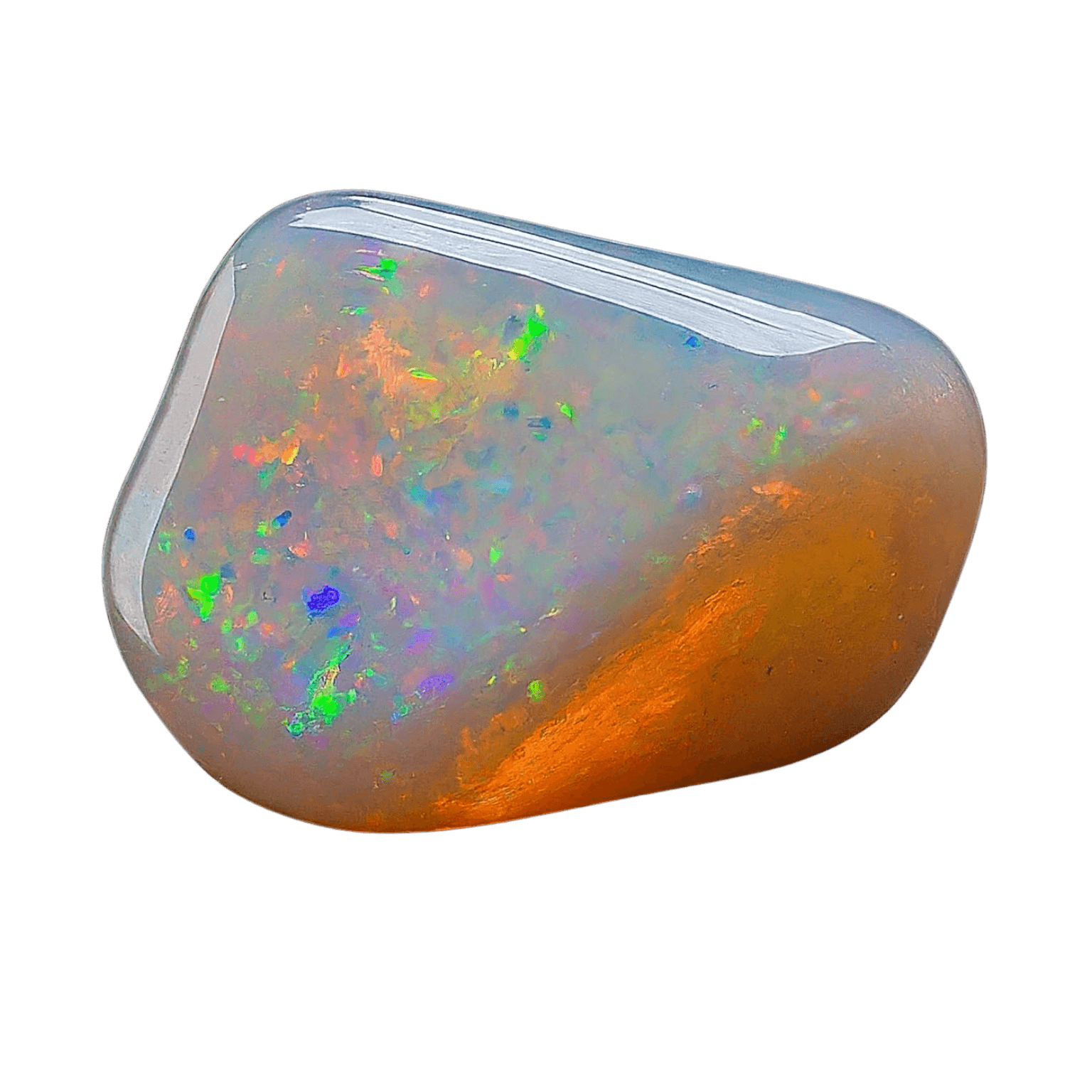
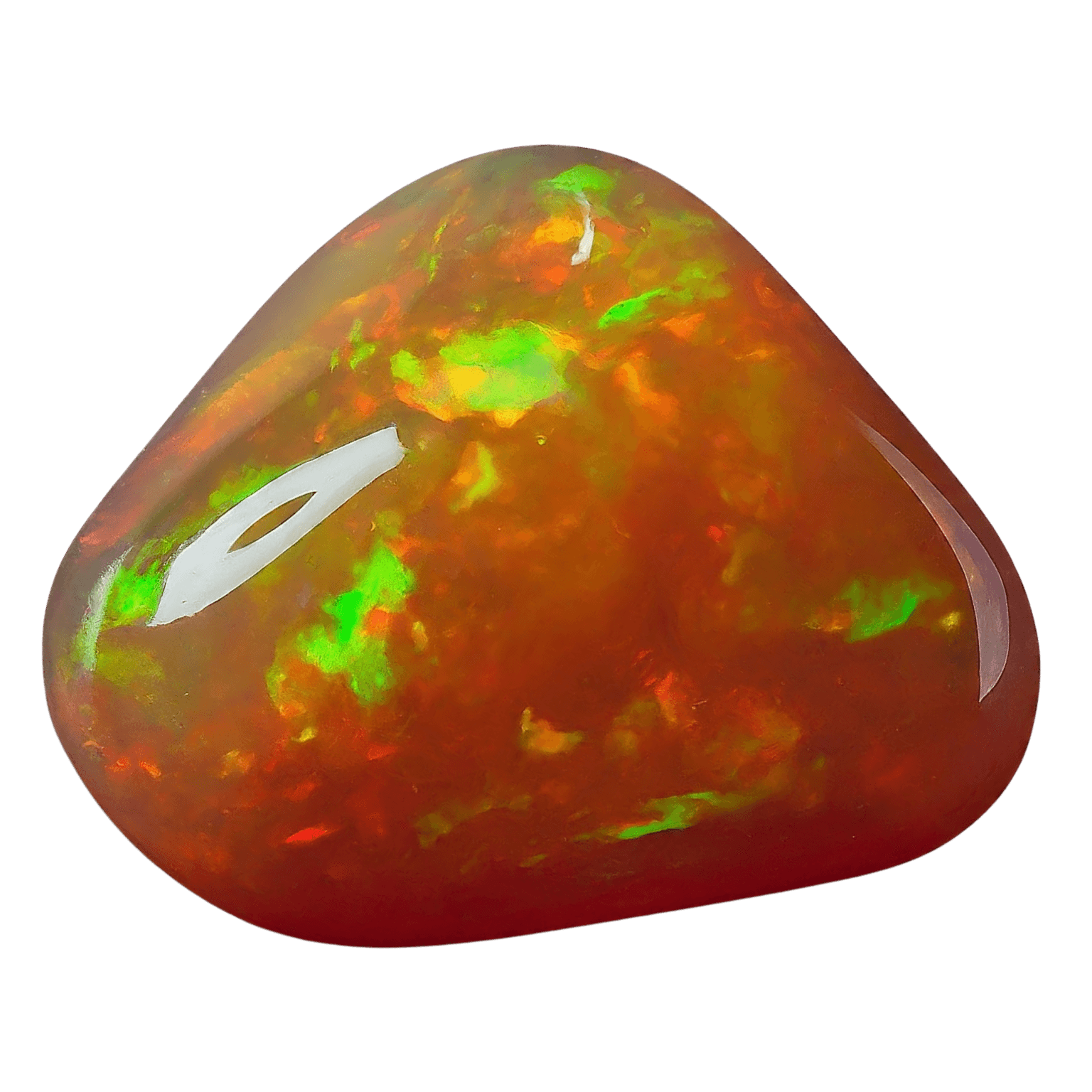
“A Queensland opal veined through ironstone, of grounded creativity and earthy fire.”
- Chakra
- Sacral (Svadhisthana), Root (Muladhara), Third Eye (Ajna)
- Zodiac
- Libra ♎, Scorpio ♏
- Element
- Water 💧, Earth 🌍
- Planet
- Venus ♀
- Hardness
- 5.75 / 10 (Mohs)
- Colors
- Blue-green flash, Brown ironstone, Purple flash, Multicolor
- Origin
- Australia (Queensland)
- Price Range
- 25 to 120
Care + Safety
Boulder Opal at a glance
- Water: avoid, may damage or leach
- Sun: fades in prolonged direct sun
- Mohs hardness: 5.75 (occasional wear only)
What is Boulder Opal?
Boulder opal is precious opal that fills thin seams and pockets in ironstone concretions, cut so a layer of the rusty host remains as a natural backing behind the color. It is mined almost exclusively in the opal fields of western Queensland, Australia, from districts such as Winton, Quilpie, and Yowah.
Boulder Opal measures 5.75 on the Mohs scale and shows blue-green flash, brown ironstone, or purple flash coloring. It sits with the activating stones, the ones brought out for creativity, grounding, and intuition when a threshold needs crossing.
The stone connects primarily to the Sacral (Svadhisthana) and Root (Muladhara) and Third Eye (Ajna) chakras, carrying Water and Earth energy. Sources include Australia (Queensland); deposit matters more than beginners expect, and collectors learn to recognize where a piece of Boulder Opal was mined by its color depth and pattern.
Boulder opal keeps its fire in the seams, veins of blue and green flash running through warm brown ironstone like creeks through desert country. Hold one and notice how imagination lights up without your feet leaving the ground. In the crystal-healing tradition boulder opal is associated with grounded creativity and intuition you can act on.
Also catalogued as Queensland Boulder Opal and Yowah Nut Opal, Boulder Opal earns its place in a working collection by being usable: start with creativity, the job it is best known for, and let the stone widen its own brief from there.
History and Mythology
There is no credible ancient chapter to tell about Boulder Opal. The species was described by modern science, and its associations with creativity were assigned by contemporary practitioners reading its color, structure, and feel. What the stone lacks in legend it makes up in geology, which asks for no embellishment; deposits worked today lie in Australia (Queensland).
In modern astrological correspondence Boulder Opal is linked with Libra and Scorpio, with Venus ♀ named as its planetary ruler. Practitioners who keep these tables often work the stone hardest during those sun-sign seasons, especially for creativity.
However young or old the human story, the stone outruns it: Boulder Opal formed over deep time, and the Mohs 5.75 piece on your shelf is the newest chapter of a very old book.
Boulder Opal Meaning and Metaphysical Properties
What the Hand Learns First
The hand learns Boulder Opal fast: a Mohs 5.75 stone whose blue-green flash face warms readily and carries a soft luster that invites the thumb to keep circling it. Check in with your spine after a minute of holding. What you find is yours to read; this family is simply worked from that end of the body rather than from the heart.
Primary Properties
The properties filed under Boulder Opal all lean forward: creativity, grounding, intuition, and manifestation. Activating stones belong to thresholds, and the old instruction is simple, touch the stone before the door opens, not after. Read each property as a cue card rather than a contract.
How Crystal Energy Works
The low belly is where tradition stations Boulder Opal: the Sacral center, home of appetite and creative current, with creativity as its natural brief. Keep the work warm and informal, hip pockets and low-belly placements, naming creativity, grounding, and intuition without making a production of it. The Judy Hall and Melody catalogs agree on where the activating family lives, the lower three centers, and on its vocabulary, will and creative fire rather than fortune.
Amplification Through Intention
Boulder Opal carries Water in the elemental system, feeling, memory, tide, and that current sets the tempo of its creativity work. Use the slow hours, journaling, the evening review, the long unwinding, and let creativity, grounding, and intuition arrive at their own pace.
Healing Benefits
Emotional Support
Confidence is where Boulder Opal meets the emotional life: creativity, grounding, and intuition. Tradition says to handle it ahead of the moments that ask you to be seen, and that small pocketing ritual carries more steadiness than its size suggests. As with all crystal healing, creativity support from a stone is reflective practice rather than medicine; significant emotional concerns deserve qualified human help.
Spiritual Connection
Boulder Opal attends the spiritual act of beginning. The traditional use is simple, take the stone in hand and say the intention out loud, letting that small rite turn a wish into a promise, and repeat it at the starts, new work, new chapters, new moons.
Physical Presence
Tradition pairs Water stones like Boulder Opal with the body's tides: rest, hydration, the wind-down hour that makes room for creativity. Let it sit on the night table as a cue for the evening glass of water and the earlier lights-out; gentle cues, never medicine.
Chakra Connection
Boulder Opal resonates most strongly with the Sacral (Svadhisthana), the energy center traditionally drawn in orange and the traditional seat of this stone's creativity work. When this center runs clear, the classical markers are warmth of feeling, comfort in the senses, and a ready creative current; creativity, grounding, and intuition are what Boulder Opal is most often asked to bring to it.
Carry it at hip level, a front pocket works fine, and give Boulder Opal a deliberate touch whenever creativity is the task at hand; sacral stones respond to rhythm more than ceremony.
Because Boulder Opal is also associated with the Root (Muladhara) and Third Eye (Ajna), it moves well in multi-stone layouts: one stone, two stations, worked on different days.
Zodiac and Astrological Connection
Astrological tradition links Boulder Opal with Libra ♎ (Sep 23 to Oct 22) and Scorpio ♏ (Oct 23 to Nov 21), and practitioners often suggest the stone meets Libra placements with the least friction.
Correspondence is a suggestion, not a bouncer; plenty of devoted Boulder Opal keepers have no Libra in their chart at all, and being drawn to the stone is the credential that matters.
The assigned ruler is Venus ♀; in practice that means Boulder Opal comes out when that planet is prominent in the sky or in your chart, and creativity is the work it is handed.
How to Use Boulder Opal
These are the five ways of working with Boulder Opal I suggest most often. Begin wherever your attention goes first; the sequence matters far less than starting.
- 1
Meditation Hold
Hold Boulder Opal for the length of your sit and notice the moment it stops feeling like an object and starts feeling like part of the hand; for a Mohs 5.75 stone, that shift comes early.
- 2
Body Placement
The chakra charts drew the Sacral center low in the belly, and Boulder Opal was rested there during reclining practice. Let the breath travel downward toward the stone if it wants to, and notice how slowly the stone takes your warmth. Practitioners in this lineage attach creativity to the position.
- 3
Sleep Companion
Boulder Opal can still earn the nightstand even though its brief is creativity rather than rest: setting the stone down as you set the day down marks the switch from doing to sleeping.
- 4
Carry With You
Take Boulder Opal along to the thresholds, the interview, the first day, the opening night, and give it one deliberate touch at the door; the gesture cues the stance that creativity takes in a body.
- 5
Crystal Grid Anchor
Use Boulder Opal as the heart of a small grid for creativity, with Opal and Fire Opal alternating on the spokes. Place the stones slowly and set the last one down with the creativity intention named out loud.
How to Cleanse and Charge
A worked stone needs clearing, and Boulder Opal is no exception; practitioners describe an uncleansed crystal as muffled, present but quieter than it should be. For the full safety profile and the cadence I recommend, see the dedicated Boulder Opal care guide.
- 1
Moonlight
Give Boulder Opal a night outdoors or at the glass under a bright moon; the tradition holds moonlight to be the universal reset, slow, cool, and risk-free.
- 2
Selenite
Keep a selenite dish where you empty your pockets and drop Boulder Opal there at day's end; the resting place does the cleansing while you sleep.
- 3
Sound
Hold Boulder Opal near a singing bowl, bell, or tuning fork and let a full minute of tone wash over it; sound reaches stones that water, salt, and sun cannot safely touch.
- 4
Sage
Smoke-cleanse Boulder Opal: light the sage, let it settle to a smolder, and move the stone through the rising smoke until your sense of it lightens, usually under a minute.
How often to cleanse
Give Boulder Opal a clearing at least every month, and sooner after hard weeks or heavy daily use. The stone will teach you its own signal in time; most people describe it as dullness, weight, or a sense the stone has gone quiet.
Charging after cleansing
Follow every cleansing with a charge: for Boulder Opal that means setting it on a selenite plate overnight or bathing it in full moonlight. A cleared stone is neutral, a charged one is ready.
Crystal Pairings
Pair Boulder Opal for ignition and steering both: an activator needs a grounding partner or the spark scatters. Its traditional companions act as governor and amplifier in turn. Run a new pair on one small creativity task first and watch what your focus does.
How to Spot Real vs Fake Boulder Opal
Imitations of Boulder Opal exist because demand does. A few hands-on checks separate genuine blue-green flash material from glass, resin, and dye:
Temperature: at Mohs 5.75, genuine Boulder Opal warms in the hand noticeably faster than glass; an imitation in glass stays cold and slick well past the first minute.
Weight and density: resin fakes run light for their size, while genuine Boulder Opal at Mohs 5.75 carries honest mineral density; weigh it in the palm against any real tumbled stone you own.
Color: expect blue-green flash, brown ironstone, or purple flash with honest variation, banding, zoning, the odd inclusion; a batch where every stone matches exactly came out of a factory, not the ground.
Price reality: the fair range for Boulder Opal sits near $25 to $120 at palm size; below that, assume treatment or imitation until the seller proves otherwise.
Trust your source: provenance beats any hands-on check; ask where the Boulder Opal was mined, whether the blue-green flash material is treated, and expect straight answers. That standard is why CrystalStones.com ships every piece with its provenance.
Bring it home
Shop Boulder Opal
Ethically sourced, hand-selected Boulder Opal starting from $25.
Shop Boulder OpalFrequently Asked Questions
What is Boulder Opal good for?
Boulder Opal is traditionally associated with creativity, grounding, intuition, and manifestation. Many people find it supportive for creativity and for working with the Sacral, Root, and Third Eye chakras.
Can Boulder Opal go in water?
Avoid it. Water can damage Boulder Opal, so stay with the dry methods its care profile lists, Moonlight, Selenite, and Sound, which cover everything this stone needs. Boulder opal's ironstone back lends strength, but its opal veins are hydrated silica; no soaking, no salt, no heat, and keep it off hot display lamps.
Can Boulder Opal be in the sun?
Treat sun as a risk for Boulder Opal: short incidental light does no harm, but hours of direct exposure will cost the blue-green flash tones their depth. Default to moonlight.
What chakra is Boulder Opal?
Boulder Opal is primarily associated with the Sacral (Svadhisthana) and Root (Muladhara) and Third Eye (Ajna) chakras. Keep it at the sacral seat while lying down, or carry it at hip level; that station is where tradition aims its creativity work.
What zodiac sign is Boulder Opal for?
Boulder Opal is traditionally connected to Libra and Scorpio. Astrological correspondence is one tradition among several, and nothing about your chart disqualifies you; people without a Libra placement work with Boulder Opal all the time.
How do I cleanse Boulder Opal?
Stick to Moonlight, Selenite, and Sound for Boulder Opal; those are the methods its care profile recommends. Dry methods make up the entire list on purpose, since this stone's chemistry asks to be kept away from moisture.
Is Boulder Opal real or fake, how can I tell?
Genuine Boulder Opal warms quickly in the hand at Mohs 5.75, while glass imitations stay cold longer and feel slick rather than satiny. Expect natural variation in its blue-green flash coloring and a price near $25 to $120 for tumbled pieces; uniform color at a bargain price is the classic warning sign.
What’s Next?
A few thoughtful next steps if Boulder Opal is calling to you.
The Crystal Starter Library
A free guide from Crystal Cassandra: the twelve stones that cover almost everything, a one page care matrix for water, sun and salt, and how to build a first intention practice.
We respect your inbox. Unsubscribe anytime.
Explore More Tools
Crystal Quiz
Discover which crystal matches your energy right now.
Open →Chakra Test
Find which chakras need attention and the crystals to balance them.
Open →Crystal Cleansing Guide
Learn how to safely cleanse and charge your crystals.
Open →Crystals by Intention
Find the perfect crystal for what you need right now.
Open →